
Chapter 4. Rebuttal without rage
What my daughter taught me about peer review and why your response should never be personal ...

A few years ago, I finished what I thought was one of my best papers yet, it was sharp, the method was nice & fancy, the discussion well-argued, and honestly? I was proud of it. I hit submit with quiet confidence. The response came back swiftly within ONE months: two reviewers, one decision.
Major revisions, with the editor already leaning toward rejection.

Reviewer one had clearly read the paper carefully and raised three concerns that were legitimate, specific, and useful. Reviewer two had apparently read a different paper entirely. Their first comment misidentified our primary outcome. Their second comment requested a differentcondition that was not just missing from our study but was incompatible with our study design, and asking us to add it would have required us to run a different experiment altogether. Their third comment critic our method while citing a body of literature from an adjacent field that I personally don’t think related to whatever we were working in.
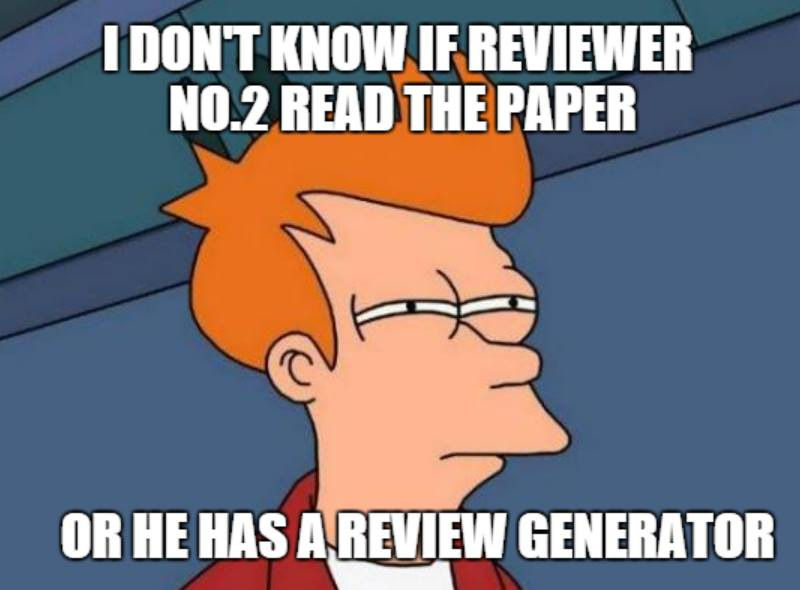
I closed the laptop and went for a walk.
When I came back, I did what most scientists do in that moment. I started drafting a response that explained, in escalating levels of detail, exactly why reviewer two was wrong. The response I wrote in that first hour was technically accurate and professionally ruinous. It was defensive in every paragraph, sarcastic in a few places that I told myself were actually just direct, and completely useless as a strategic document. It would not have helped the paper. It would have confirmed to the editor that this author was difficult to work with, and it would have sent the manuscript toward rejection faster than the problematic review itself.
FYI, I did not send that version. But I did not delete it either, and somewhere around the third paragraph my daughter Scarlett walked into the room, glanced at the screen, and asked what I was writing. I told her someone had said something unfair about my work and I was explaining why they were wrong. She thought about it for a moment and then said, with the complete calm of a person who has not yet learned to overcomplicate things:
“But if they’re already wrong, why do you need to be mean about it?”
She was not offering advice, just asking a question. But the question landed somewhere I hadn’t expected, because the honest answer was that I didn’t need to be. The wrongness didn’t require my anger to be true. It would still be wrong in a quieter sentence.
I closed that draft, opened a new document and started again.
Peer review, well, everything is about peer review
Science training prepares you for a great many things. It prepares you to design experiments, to analyse data under uncertainty, to defend a methodological choice in front of an expert committee, and to revise a manuscript in response to feedback that is specific and actionable. What it does not prepare you for is the emotional reality of structured, repeated rejection.
The particular kind of rejection that comes with peer review is one of the more psychologically complex varieties on offer. You are receiving a judgment on work you may have spent years on, written by a person whose identity you do not know, who was not chosen by you, who may or may not have the relevant expertise, and whose comments you are nevertheless obligated to address if you want the paper published. You cannot ask for clarification before you respond. You cannot assess the reviewer’s qualifications. You cannot choose a different reviewer the way you might choose a different colleague to consult.
Peer review is a highly variable process that produces everything from genuinely transformative critique to comments that would embarrass a first-year student. The working scientist learns, often slowly and without much guidance, to receive both kinds of feedback with the same outward equanimity. Nobody teaches this skill, nobody sits you down and explains that the majority of your professional career will involve some form of being told no, and that learning to respond to that no without losing either your scientific integrity or your professional composure is a skill you will use more than almost any other.

Understanding what really is a rebuttal letter ?
The most important reframe in this chapter is one that sounds simple but changes everything about how you approach the process. A rebuttal letter is not a defence, IT NEVER IS. I consider a rebuttal letter as a persuasion document.
You are not trying to prove that you are right, and the reviewer is wrong (even when you are right and the reviewer is wrong LOL). You are trying to persuade the editor to send the revised manuscript to publication. The editor is your actual audience. The reviewer is a voice in the room that you need to manage, but the editor is the person whose confidence you are trying to earn and keep. Every decision you make in the rebuttal letter should be made with that distinction in mind.
This reframe has practical consequences. Even when reviewer two is wrong, your job is not to expose that wrongness in the most complete and undeniable terms available. Your job is to correct the record in a way that makes the editor confident that the paper is scientifically sound and that the author is someone worth working with. Those are related & they serve different goals. Achieving the first by humiliating the reviewer achieves the second only if the editor has no interest in maintaining a functional review system (well, which is unlikely)
The three types of reviews
Not all critical feedback deserves the same response, and learning to categorise reviews accurately before you start writing is one of the highest-leverage habits you can develop as a working scientist.
The genuinely helpful critique arrives when a reviewer has read carefully, identified a real gap or weakness in your argument, and articulated it in a way you can act on. This is the version of peer review the system was designed to produce, and also, in my experience, the least common of the three types. When you receive it, the response is substantive and direct. You describe what the reviewer raised, explain what change you made and why it improves the paper, and thank the reviewer in language that is genuine rather than formulaic. The only trap here is overclaiming in your response (and guess what, editors know what overclaiming looks like)
The review outside the reviewer’s expertise is more delicate than it first appears. The reviewer is not being malicious. They were assigned a paper that pushed against the edges of what they know, and their comments reflect that mismatch. The language pattern that works here validates the underlying concern while reorienting it toward the correct disciplinary context. Something like “Reviewer two raises a question about our choice of threshold, which reflects a convention that differs between the literature, and the genomics approaches our study draws from” allows you to correct the record while treating the reviewer as someone working from a different but legitimate framework. You are not agreeing with them. You are explaining, to the editor’s satisfaction, why the critique does not apply.
The review that is simply wrong requires the most careful handling, because the temptation to be definitive is highest when you know with most confidence that you are correct. A reviewer who misidentifies your outcome variable has made a factual error that needs to be corrected, but the correction does not need to carry additional weight. State what your outcome variable was, point to the section where it was defined, indicate whether any clarification has been added in the revision, and move on. The tone is informative rather than corrective. Long explanations in this situation often read as defensiveness even when the underlying argument is airtight. Brevity here is a form of confidence.
